← Journal

Journal

Sweet Annie, wormwood or mugwort: how to tell them apart

Three plants share the name Artemisia, and often the same common names. Here is how we tell them apart in the field, in a bag and on a label.

The genus Artemisia has several hundred species. Three of them come up again and again in herb shops and in online searches: sweet Annie (Artemisia annua), wormwood (Artemisia absinthium) and mugwort (Artemisia vulgaris). They are related, but they are not interchangeable.

The common names make it harder. “Wormwood” is used for both A. absinthium and A. annua (sweet wormwood). In French, all three are often simply called armoise. The only name that never changes is the botanical one.

We grow one of the three, Artemisia annua, in La Baie, Québec. Here is what we look for.

At a glance

The three plants side by side

On a phone, swipe the table to the left to see all three columns.

Sweet AnnieArtemisia annuaWormwoodArtemisia absinthiumMugwortArtemisia vulgaris
Other namesSweet wormwood, annual wormwood, qing haoAbsinthe, grand wormwoodCommon mugwort
Life cycleAnnual: grows from seed and dies each yearPerennial, woody at the basePerennial, spreads by rhizomes
Height1 to 2 m (3 to 6 ft)0.5 to 1.2 m (2 to 4 ft)0.5 to 2 m (2 to 6 ft)
LeavesBright green, hairless, very finely divided, like a fernSilver-grey, silky, with rounded lobesDark green on top, with broad pointed lobes
Underside of the leafGreen, same as the topSilver-grey, same as the topPale and woolly, often whitish
Flower headsTiny (about 2 mm), round, yellow-green, noddingLarger, round, dull yellow, noddingSmall, oval, upright, yellowish to reddish-brown
ScentSweet, fruity, camphor-likeStrong and sharp; very bitter tasteMild, herbal
Best known forThe species that produces artemisinin; dried aromatic wreathsAbsinthe and vermouthA wild roadside plant; a traditional seasoning herb
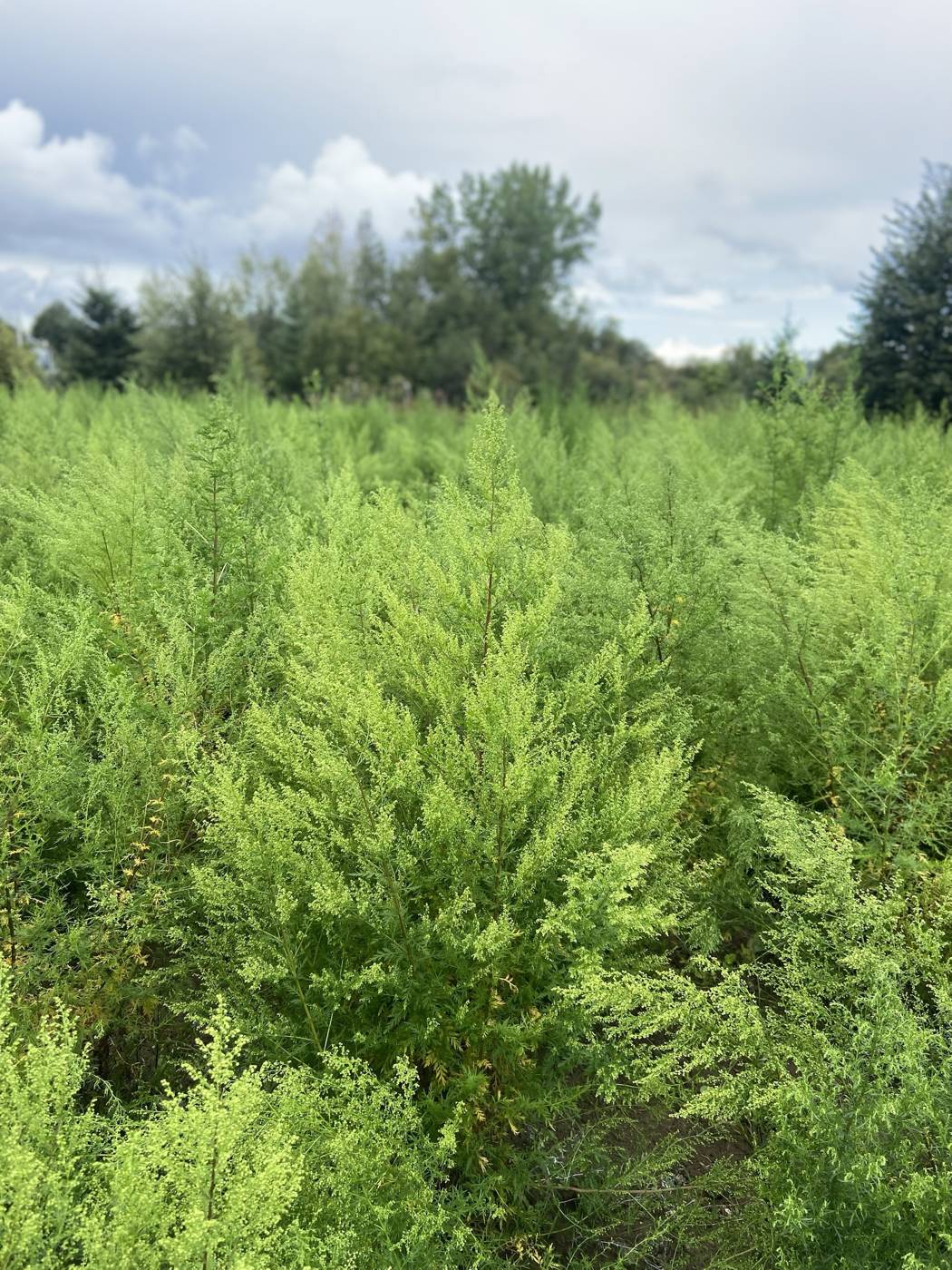
Bright green, finely divided foliage of Artemisia annua in the field in La Baie, Québec
Artemisia annua

Sweet Annie

Sweet Annie is an annual. On our farm, the plants we set out in early June are harvested in September, and nothing comes back the next year: we replant.

The foliage is the best clue. It is bright green on both sides, hairless, and cut so finely that it looks like a fern or a carrot top. The stem is ribbed.

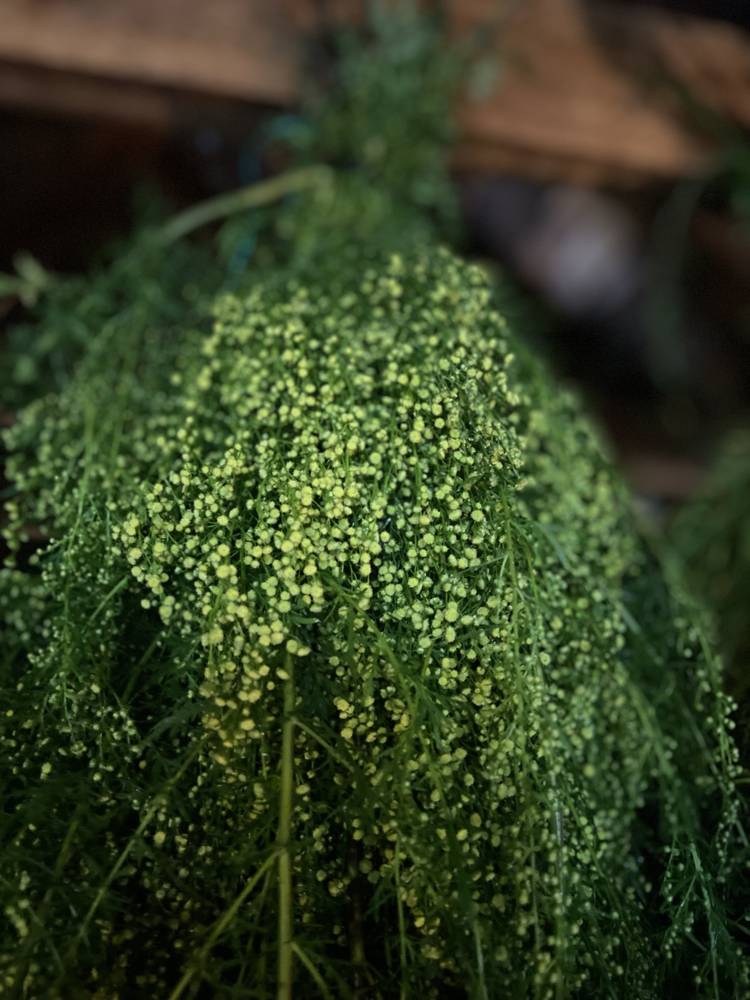
The flowers come late, when the days shorten: thousands of tiny, round, yellow-green, nodding flower heads. Crush a leaf and the scent is sweet, fruity and camphor-like. That scent is where the name comes from.

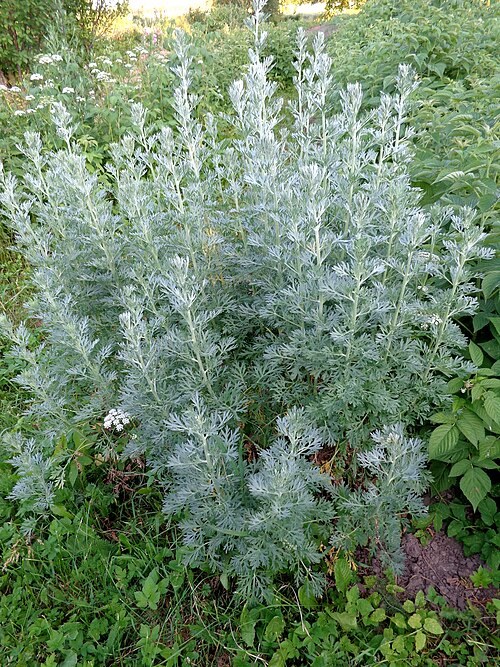
Clump of wormwood (Artemisia absinthium) with silver-grey foliage
Photo: author named on Wikimedia Commons, CC BY-SA 3.0 (cropped)

Wormwood

Artemisia absinthium

Wormwood is a perennial with a woody base, so it regrows every spring from the same crown. You can recognise it from a distance by its colour. The whole plant is silver-grey, because the leaves are covered in fine, silky hairs.

The leaf lobes are wider and more rounded than those of sweet Annie. The flower heads are dull yellow, round, nodding and clearly larger.

The scent is strong and the taste is intensely bitter. It is the plant behind absinthe, and the one that gave vermouth its name (from the German Wermut). Its essential oil can be rich in thujone, a compound whose levels are regulated in foods and beverages in many countries.
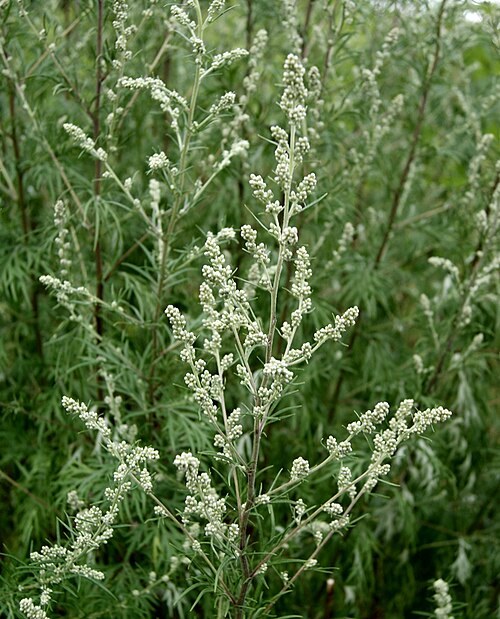
Mugwort (Artemisia vulgaris) in flower, with reddish-brown stems
Photo: Danny S., Wikimedia Commons, CC BY-SA 3.0 (cropped)

Mugwort

Artemisia vulgaris

Mugwort is the one many people have already seen without knowing it: it grows wild along roadsides, ditches and vacant lots. It is a perennial that spreads by underground stems, which is why it forms dense patches.

The best test is to turn a leaf over: dark green on top, pale and woolly underneath, often whitish. Neither of the other two has that two-coloured leaf.

The stems are often reddish-brown, the lobes are broad and pointed, and the small oval flower heads stand upright. Its scent is mild compared with the other two.

Tiny, round, yellow-green flower heads of Artemisia annua hanging to dry
In the field

Five quick checks

  1. Read the botanical name. It is the only one that cannot be confused.
  2. Turn a leaf over. Pale and woolly underneath: mugwort.
  3. Look at the colour. Silver-grey all over: wormwood. Bright green on both sides: sweet Annie.
  4. Crush and smell. Sweet and fruity: sweet Annie. Strong and bitter: wormwood. Mild: mugwort.
  5. Ask whether it comes back each year. If it has to be reseeded, it is sweet Annie.
In a bag

What about dried herb?

Once a plant is dried and cut, it is harder to recognise. Dried sweet Annie stays green to yellow-green, with a mass of tiny round flower heads and its sweet scent. Dried wormwood looks grey. Dried mugwort shows pale flecks from the underside of the leaves.

For certainty, you need a laboratory identification. That is why each of our lots is identified by PhytoChemia, an independent laboratory in Saguenay, by macroscopic examination and by thin-layer chromatography, then tested for artemisinin, the compound characteristic of Artemisia annua.

On a label, look for four things: the botanical name, the plant part, the origin and the lot number.

References

Botanical descriptions checked against: Oregon Flora and Flora of North America, Artemisia vulgaris; Illinois Wildflowers, Artemisia annua; Minnesota Wildflowers, Artemisia absinthium. The notes on sweet Annie come from our own field.

This article is about plant identification. It contains no health advice.